
Michelson Interferometry (ASTM E289) compared to Pushrod Dilatometry (ASTM E228)
| Capabilities: | Interferometer (ASTM E289): | Dilatometry (ASTM E228): |
|---|---|---|
| Resolution: | 3.0 nanometers | 76.2 nanometers |
| Min & Max Temp. range: | -269 °C to 1000 °C * | -185 °C to 1400 °C * |
| Estimated CTE range of the material tested by the method: | 0 µm/(m·°C) to 10 µm/(m·°C) | ≥ 5 µm/(m·°C) |
| Estimated CTE uncertainty for test: | 10 nm/(m∙°C) or up to 1 % of the estimated CTE | 100 nm/(m·°C) or up to 5 % of the estimated CTE |

What is similar between Interferometry and Dilatometry?
For both methods, the Coefficient of Thermal Expansion (CTE) is measured continuously over the entire temperature range, and data are reported every 1 °C or 1 minute.
Which method is better for measuring the CTE of your material?
The short answer: It depends! The estimated CTE of the material, application, sample dimensions, material rigidity, and temperature all play a role in the test type used to measure CTE. PMIC has developed specialty test methods for testing powders, liquids, and fabrics.
PMIC’s Interferometer resolution is suitable for real-time shift measurements of components with CTE values as low as 0.01 µm/(m·°C).
Michelson Interferometry: Used for materials that generally have a low CTE. The Michelson Interferometer yields a resolution ~96% higher than measurements performed via dilatometry. See Figure 1 for an example of a basic Michelson Interferometer setup for X-direction (length) or Y-direction (width) measurements.
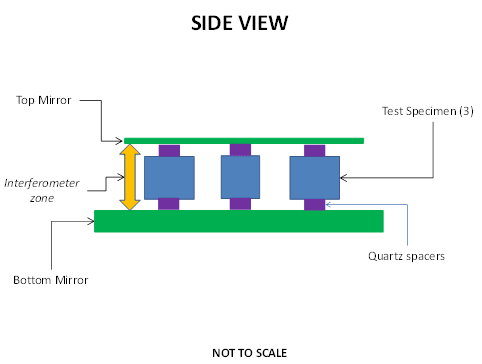
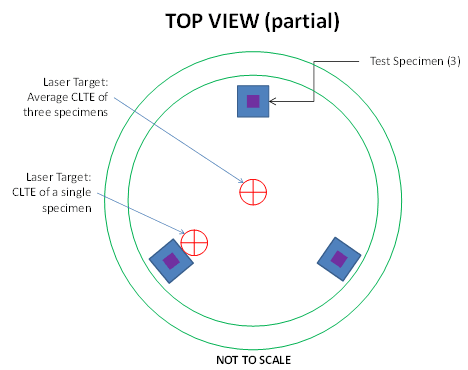
Interferometer Z-direction (through-thickness) measurements are made using special setups, such as shown in Figure 2 and 3. PMIC research is cited in the ASTM E289 standard.
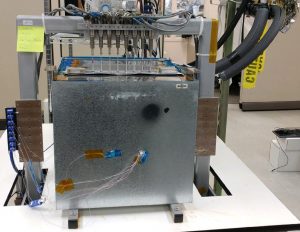
PMIC performs dilatometry testing on materials with a higher CTE that do not require as high of resolution as the Michelson Interferometry test method. PMIC offers a variety of dilatometry methods based on material types. PMIC dilatometers utilize linear variable displacement transducers (LVDTs), which convert a change in measured length to a voltage change. Please see Figure 4 for a standard LVDT system.
Pushrod Dilatometry: PMIC thermal cycles specimens over the requested temperature range and the temperature and length change are continually recorded. The mean coefficient of thermal expansion is then reported over one full temperature cycle. Additional test cycles are available upon request.
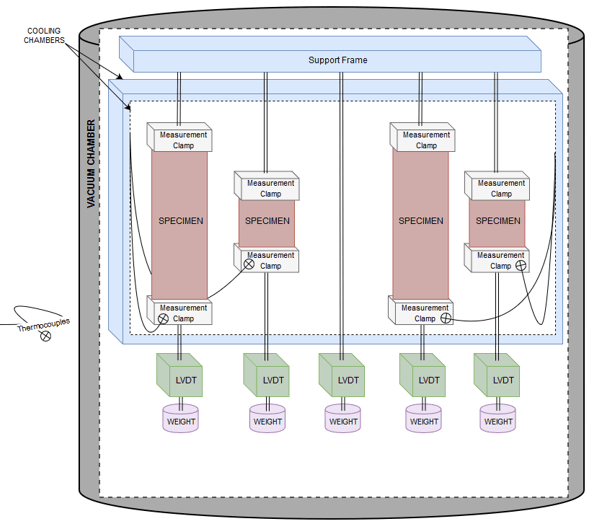
Hanging Dilatometry: PMIC engineers have modified ASTM E228 to handle flexible materials that lack rigidity such as fabrics, thin laminates, metallic foils, and other non-rigid solids. This method measures both a long and short specimen of the same material to account for error induced by specimen clamps. Please see Figure 5 for more information.
Why choose PMIC for your CTE testing needs? PMIC’s Interferometer and Dilatometer systems boast higher-than-industry-standard resolution, cryogenic testing at temperatures as low as -269 °C, and flexible specimen geometry. With over 50 years of combined experience, PMIC engineers are at the forefront of CTE research and testing. If you have questions about the suitability of your materials and the appropriate test methodology, please contact us.